

Legal Risks, IRCC Audits & Protecting Your Clients' PR Path
Legal Risks, IRCC Audits & Protecting Your Clients' PR Path
Updated 20-Aug-2025 • 10 min read
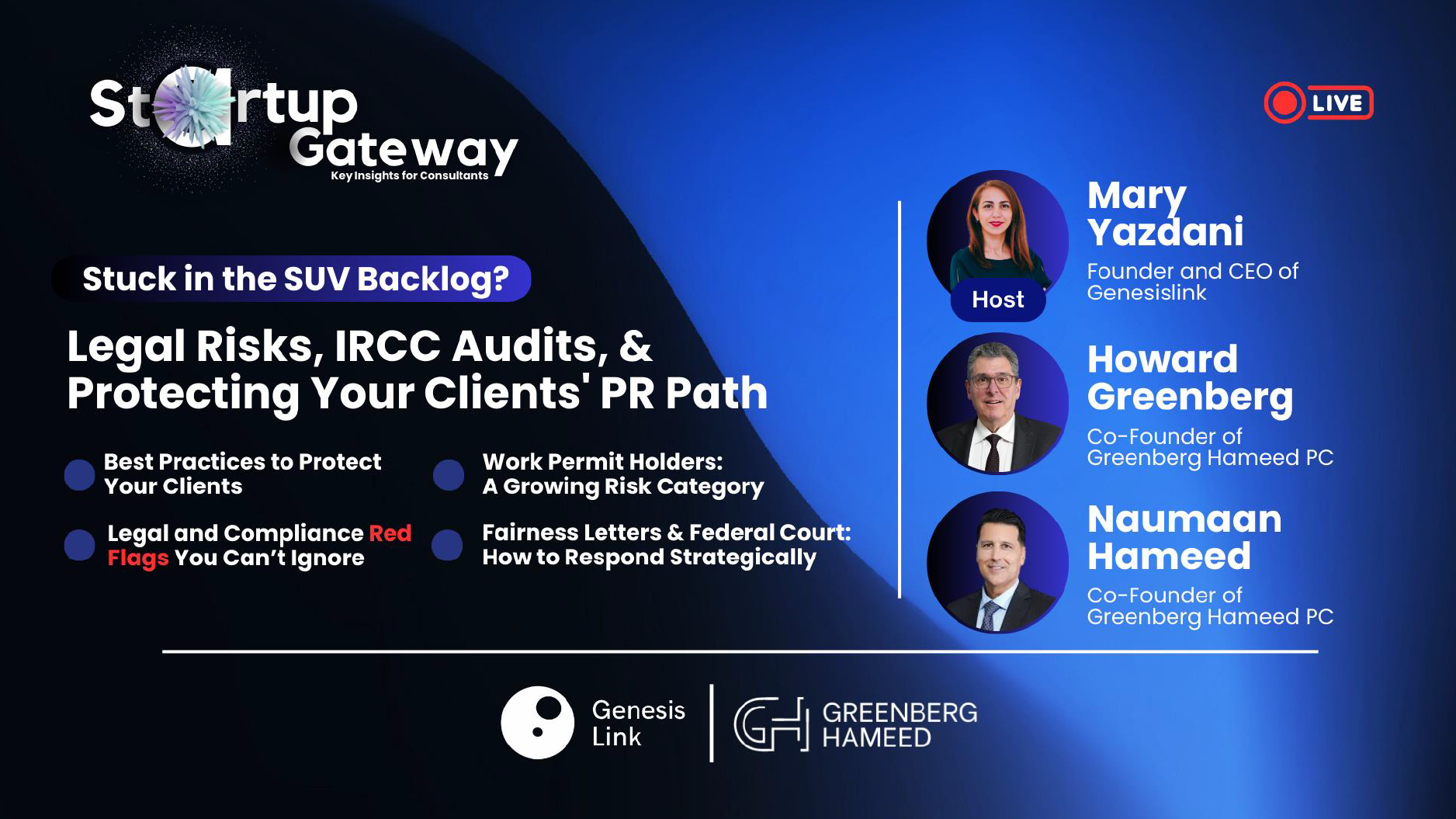
In this Startup Gateway webinar hosted by Mary Yazdani, Founder of GenesisLink, immigration professionals and Startup Visa (SUV) applicants came together for a timely and candid discussion on IRCC audits, interviews, procedural fairness letters, and legal risk management.
With SUV processing times stretching into multiple years, increased integrity reviews, and heightened scrutiny on work permit extensions, the session focused on one core question:
How do you protect a Startup Visa file from submission to PR approval — without creating new risks along the way?
Guest speakers Howard Greenberg and Noman Hammed, co-founders of Greenberg Hammed, shared frontline legal insights drawn from audits, refusals, and Federal Court litigation.
You can watch the full recording above or read the written summary below.
Why IRCC Audits and Interviews Are Increasing
Mary opened the session by framing the realities many consultants now face:
- Longer PR backlogs
- More integrity checks
- Increased direct contact with applicants
- Higher expectations of post-filing compliance
Howard explained that when IRCC conducts audits or interviews, officers are performing a side-by-side comparison:
“They have the commitment certificate in one hand and the business plan in the other.”
The decisive question officers are asking:
Are the founders actually doing what they said they would do?
By the time an officer contacts an applicant, one to three years may have passed. At that stage, IRCC expects to see real activity, not intentions.
Preparing for IRCC Calls and Interviews
A key takeaway was clear: surprise calls should not truly be surprises.
Preparation is a shared responsibility between:
- The consultant
- The designated organization
- All founders (not just one)
Best practices when contacted by IRCC:
- Review the original commitment certificate
- Review the business plan
- Align answers strictly to those documents
- Avoid speculation or improvisation
“What you say on the phone becomes evidence.”
Mary reinforced this with real-world examples where stressed applicants gave inconsistent answers, creating unnecessary legal exposure.
If an applicant is not ready to respond, requesting a callback is safer than guessing.
Where IRCC Scrutiny Is Most Intense Today
Noman highlighted work permit extensions as a major audit trigger.
An integrity unit within IRCC now frequently:
- Calls applicants directly
- Asks detailed questions about daily activities
- Verifies incorporation, contracts, revenue, and progress
Information gathered is shared with adjudicating officers and can directly influence outcomes.
Emerging trend: IRCC is increasingly reviewing designated organizations themselves, stepping into a role once assumed to be handled by oversight bodies.
The Most Common Legal & Compliance Red Flags
Recurring issues that trigger refusals or procedural fairness letters include:
- Incomplete or weak business plans
- Poor role justification for essential members
- Post-filing changes to commitment certificates
- Adding or removing essential members after filing
- Language requirements not met at the time of submission
Critical clarification
IRCC is now applying newer interpretations retroactively in some cases — meaning older files may be assessed under updated standards.
Howard drew an essential distinction:
- Business evolution is acceptable
- Fundamental change is not
“You can’t turn one business into another and expect the certificate to still stand.”
Fatal vs. Fixable Mistakes
Not all mistakes carry the same weight.
Howard explained:
- Fatal issues (e.g., essential member withdrawal) often collapse the entire file
- Procedural or administrative errors may be defensible
He shared a Federal Court example where a commitment certificate was not properly transmitted by a designated organization. Because the certificate was included with the PR application, IRCC ultimately reversed its refusal.
Lesson:
Every refusal must be analyzed individually — never assume the outcome is final.
Procedural Fairness Letters: What They Really Signal
Procedural fairness letters are one of the most stressful moments in an SUV file, but their purpose is often misunderstood.
“It’s open season — any aspect of the application can be questioned.”
Common triggers include:
- Financial capacity
- Role credibility (e.g., unqualified CTOs)
- Genuineness of business activity
- Essential member participation
Crucially, all arguments must be raised at the fairness-letter stage, including requests for:
- Substituted evaluation
- Economic establishment considerations
Arguments raised after refusal may be excluded from review.
When (and When Not) to Go to Federal Court
Noman outlined situations where Federal Court review is most viable:
- The officer ignored evidence already on file
- Regulations or policy were misapplied
- The applicant was denied a chance to respond
Not every refusal belongs in court. With long backlogs, strategic case selection matters.
Many cases are resolved through early settlement or reconsideration once legal weaknesses are identified.
Managing Client Stress and Expectations
Client psychology was a recurring theme throughout the session.
Howard noted that fairness letters often cause clients to blame consultants, even when no error occurred. Clear communication helps preserve trust:
“These letters are common. The system has flaws. This is not a personal failure.”
Experienced counsel often act as a neutral sounding board, helping restore consultant–client relationships.
Work Permit Risks During Long PR Backlogs
For founders already in Canada, extended backlogs create new exposure:
- Repeated work permit extensions
- Increased scrutiny with each renewal
- Financial pressure due to cost of living
Noman highlighted two recurring risk areas:
- Activity gaps
- Settlement fund maintenance, especially with currency depreciation
To manage this, the firm uses structured activity tracking aligned with the original commitment certificate and updated continuously as officer expectations evolve.
How Much Evidence Is Enough?
There is no universal checklist.
A practical test:
- Does the evidence show genuine effort?
- Is it consistent with the certificate and business plan?
- Is it realistic for the industry?
One-line claims (e.g., “we did market research”) are weak.
Structured evidence (interviews, findings, pilots) is persuasive.
At the same time, overwhelming officers with hundreds of pages can backfire — quality, relevance, and consistency matter more than volume.
One Guiding Principle for Staying Compliant
When asked for a single piece of advice, Howard summarized it simply:
“Start with the certificate. Follow the business plan.
Do what you said you would do — and be able to prove it.”
Key Takeaways for Immigration Professionals
- IRCC audits and calls are becoming routine, especially at extension stages
- Phone interviews are evidence — preparation is non-negotiable
- Procedural fairness letters are legal warning signals, not explanations
- All remedial arguments must be raised before refusal
- Not every refusal belongs in Federal Court — but some absolutely do
- Ongoing file management is a professional obligation
- Strong documentation protects both the client and the consultant