


From Idea to Invetment What VCs look for in Stratup Visa Program
From Idea to Invetment What VCs look for in Stratup Visa Program
Updated 25-Mar-2025 • 12 minutes read
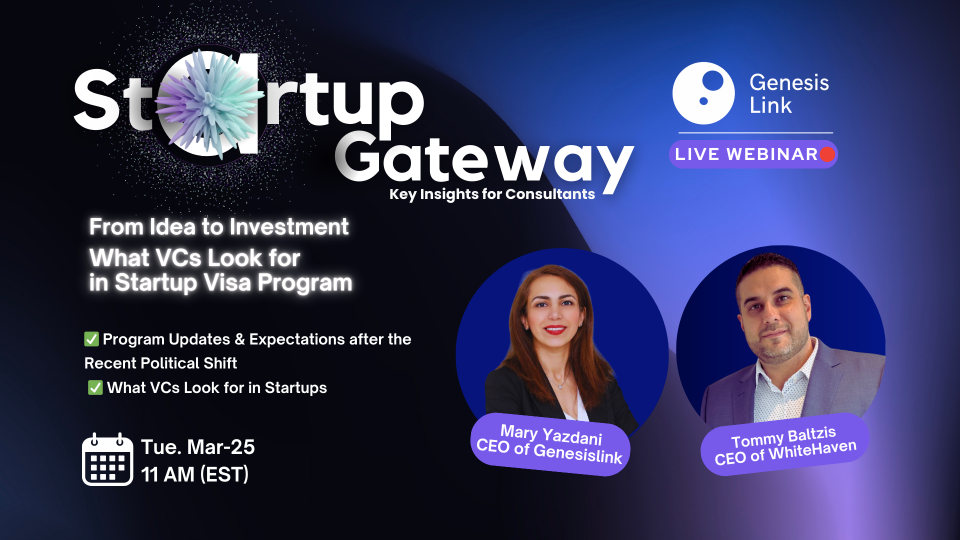
In the second episode of the Startup Gateway webinar series, hosted by Mary Yazdani, Founder & CEO of GenesisLink, the conversation zoomed out to examine how global politics, venture capital behavior, and technological disruption are reshaping Canada’s Startup Visa (SUV) ecosystem.
The session featured Tommy Baltzis, CEO of White Haven — a Designated Organization under the Startup Visa Program and a seasoned voice in global finance, geopolitics, and alternative investments.
What emerged was not a tactical “how-to,” but a strategic reality check for founders, immigration professionals, and ecosystem partners navigating SUV amid unprecedented uncertainty.
The World Has Changed — and It’s Not Going Back
Tommy opened with a blunt premise:
“The world is not going back to 2019.”
Drawing on his experience at global forums such as Davos / World Economic Forum, he framed today’s moment as a return to historical normalcy — not an anomaly.
Key macro observations:
- The past 75 years have been unusually stable by historical standards
- Global economic growth is slowing
- Governments are overextended and highly leveraged
- We are entering an era of economic warfare, not military conflict
Trade tools — tariffs, sanctions, and legal mechanisms — have replaced tanks.
For founders, this means:
- Geopolitical risk is no longer “external”
- Immigration, capital flows, and innovation policy are now tightly linked
U.S.–Canada Tensions: Why Tariffs Matter for Immigration
Referencing his article “The Tariff Gambit: Trump’s Poker Face vs Canada’s Last Hand”, Tommy explained why U.S. trade posture directly affects Canada’s immigration climate.
His core argument:
- The U.S. increasingly questions Canada’s reliability as a strategic partner
- Issues such as financial crime enforcement, foreign influence, and fentanyl flows shape trust
- Tariffs are signals, not just economic tools
“Don’t focus on what Trump says. Focus on what he does.”
This erosion of trust matters because:
- Immigration openness depends on perceived national stability
- Capital prefers predictable jurisdictions
- Canada’s positioning is under scrutiny
Immigration in an Age of Political Uncertainty
Mary underscored a key shift:
“Uncertainty is no longer regional — it’s reached North America.”
Elections, trade wars, and policy volatility now influence:
- Founder relocation decisions
- Investor risk appetite
- Program scrutiny at IRCC
For SUV applicants, political timing has become a background risk variable, even when eligibility criteria remain unchanged.
Venture Capital Under Uncertainty: Why Money Is Waiting
One of the most practical insights concerned VC behavior.
Tommy described today’s capital markets as:
- Cash-rich but cautious
- Dominated by dry powder waiting on the sidelines
Why?
- Tariff volatility
- Unclear global supply chains
- Unpredictable regulatory environments
“Uncertainty doesn’t kill capital. It freezes it.”
For startup founders, this means:
- Stronger narratives are required
- Readiness matters more than hype
- Trust and referrals matter more than cold outreach
AI: The Most Misunderstood Opportunity
AI dominated much of the discussion — but not in the way many expect.
1) AI Is a Disruptor — But Not a Shortcut
- Comparable to the Industrial Revolution
- Threatens white-collar work, not just blue-collar jobs
- Downstream impact remains unknown
2) AI Is Resource-Constrained
High-powered AI requires:
- Massive energy
- Advanced chips
- Data infrastructure
“There are not enough chips in the world to do everything people want to do with AI.”
3) AI Is Not a Differentiator by Itself
Tommy was explicit:
“If someone comes to me and says ‘I have an AI startup,’ I’m not interested.”
What matters instead:
- The problem being solved
- The vision
- The business model
- How technology supports the strategy
AI should improve execution, not replace a weak concept.
Why White Haven Avoids Fads
Tommy shared White Haven’s long-standing philosophy:
- Avoided crypto at peak hype
- Avoided EV speculation
- Invested instead in foundational infrastructure (e.g., Nvidia in 2017)
This philosophy carries directly into SUV decisions:
- Trends fade
- Fundamentals endure
For founders:
- Chasing buzzwords weakens credibility
- Long-term value creation matters more than narrative alignment
VC-Backed SUV: Why Approval Rates Lag
Mary referenced IRCC data (up to April 2024) showing that VC-backed SUV applications had lower approval rates than expected.
Tommy explained why:
- VC-backed cases often involve:
- Cross-border expansion
- Market transferability questions
- Higher scrutiny on economic fit
In contrast:
- Incubator-backed cases surged post-COVID due to volume and policy leniency
Going forward:
- Later-stage, market-ready companies may be favored
- Canada wants faster job creation and clearer economic outcomes
Canada’s Structural Reality: Why SUV Will Continue
Despite uncertainty, Tommy was unequivocal:
“Canada needs immigration. Period.”
Key drivers include:
- Low birth rate
- Mass baby-boomer retirement
- Weak GDP growth forecasts (OECD rankings)
Startup Visa fits a structural need:
- Innovation
- Entrepreneurship
- Global talent attraction
The program may tighten — but it will not disappear.
What White Haven Looks For (Under the 10-LOS Cap)
With IRCC limiting Designated Organizations to 10 Letters of Support per year, selection has become strategic.
White Haven evaluates:
- The people — founder credibility, resilience, track record
- The stage — later-stage reduces risk, but is not mandatory
- Economic impact in Canada — jobs, IP, long-term presence
Crucially:
- IP extraction (e.g., moving IP to Ireland) is a red flag
- Canada must benefit beyond incorporation
“We’re not just investing money. We’re telling the government these people should be here.”
Investment Reality: The $200K Rule
Tommy clarified a common misconception:
- $200K is a minimum — not a meaningful amount for most businesses
Context:
- A basic restaurant can cost $600K–$1M
- Scalable tech or manufacturing requires far more
Typically:
- Funds are released after LOS and before PR, depending on risk and stage
Priority Processing: Expectations vs. Reality
On priority processing, the message was sobering:
- Timelines range widely: 9 to 36 months
Influenced by:
- Officer turnover
- Timing in the year
- Political events
- Internal IRCC capacity
“Government will always move slower than the private sector.”
There is no guaranteed fast track, despite policy language.
Strategic Advice for Founders (This Matters)
Tommy’s strongest advice focused on process, not paperwork:
- Build relationships early
- Enter through trusted channels
- Avoid cold outreach to Designated Organizations
- Get vetted by ecosystem intermediaries
“Sending a random pitch deck doesn’t work in Canada.”
Preparation, credibility, and patience now outweigh speed.
Sectors That Actually Make Sense for Canada
White Haven is not industry-fixated — but certain themes align with Canada’s reality:
- Robotics & automation (labour shortages)
- Healthcare and elderly care technologies
- Agri-tech with consolidation models
- Renewable energy with export potential
Canada’s structural challenges:
- Small domestic market (~40M population)
- Aging workforce
- Need for global scalability
Final Takeaways
- Political risk now shapes immigration outcomes
- Venture capital is cautious — but available
- AI is a tool, not a thesis
- Canada still needs entrepreneurs
- SUV will evolve — but remain relevant
- Trust, readiness, and real economic impact matter more than ever
“This is the largest shift in immigration in human history.”