


From Letter of Support to Landing: What Drives a Credible, Compliant SUV File (Evidence, Due Diligence & Remote Traction)
From Letter of Support to Landing: What Drives a Credible, Compliant SUV File (Evidence, Due Diligence & Remote Traction)
Updated 07-Oct-2025 • 9 min read
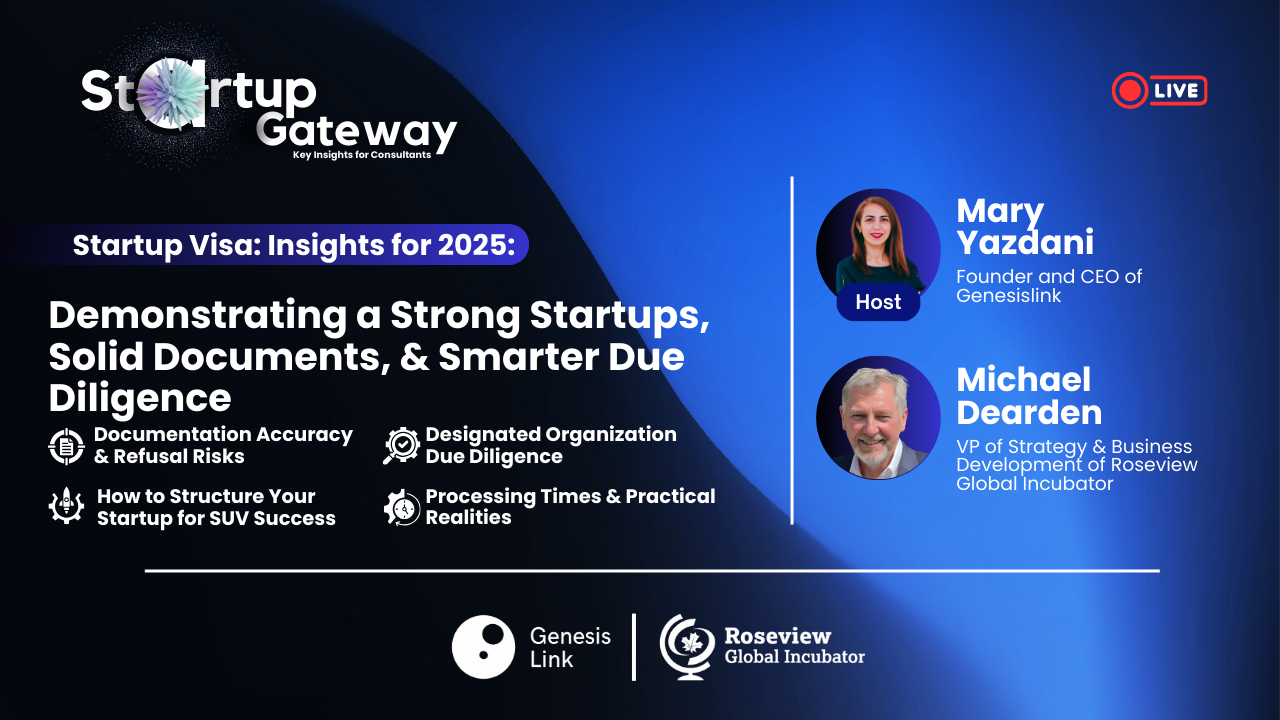
In this Startup Gateway webinar hosted by Mary Yazdani (GenesisLink) with guest speaker Michael Dearden (Roseview Global Incubator), the discussion focused on what actually makes a Start-Up Visa (SUV) file credible — from precision documentation and designated-organization due diligence to remote traction proof, hiring plans, and proactive file management during long processing timelines.
Rather than treating the SUV as a one-time submission, the session emphasized building a living evidence system that stays consistent across the Letter of Support (LOS), work permits, PR processing, and landing.
Setting the Standard: Documentation Is the Foundation
Mary opened with a clear message: strong SUV files are built on evidence precision, complete documentation, and real-world proof — not vague claims.
She framed the webinar as a practical roadmap:
- What designated organizations (DOs) and IRCC expect to see
- Where weak files typically fall apart
- How founders can demonstrate traction even before arriving in Canada
A recurring theme was GenesisLink’s “single source of truth” approach — helping founders, consultants, and DOs stay aligned through one structured evidence folder that evolves over time.
What Designated Organizations Look for (and Why It Matters)
Michael explained Roseview’s baseline requirements:
- Full business plan
- Pitch deck
- Financials (company + personal)
- Founder CVs
- Language results
- Traction evidence (from Canada or the home market)
This documentation is what enables Roseview to write a strong commitment certificate and issue an LOS with confidence.
One point was emphasized clearly:
“We spend a lot of time working on the commitment certificate…
We don’t ask our clients to do it.”
Roseview prepares the commitment certificate internally to ensure consistency and quality.
The Biggest Gaps: Traction and Financials
When asked what tends to be weak even in otherwise strong applications, Michael highlighted two recurring gaps:
- Financial clarity
(business funding readiness + personal capacity to sustain) - Client traction evidence
(proof the market actually wants the solution)
“The two — financials and client traction — are critical.”
Mary noted that founders often struggle to present financial realities cleanly, especially when navigating different tax systems and reporting standards internationally.
What “Best-in-Class” Due Diligence Looks Like at a DO
Michael walked through Roseview’s multi-stage due diligence process:
- Structured application intake via their platform
- Review of:
- 40–50 page business plan
- Pitch deck
- Company and personal financials
- Cap table
- Language results
- Founder CVs
- Founder-only interview (1 hour, no advisors)
- Additional interviews with partners covering:
- Financial assumptions (accountant partner)
- Pitch clarity and positioning (communications/branding partner)
- Execution feasibility (Michael’s focus)
A notable insight: historically, many applicants never reached due diligence because they were not ready — though that is changing as the bar rises.
Red Flags That Kill Files Early
From an investor-style lens, Michael emphasized the number-one filter: the team.
If founders:
- Can’t explain the business clearly
- Don’t demonstrate execution ability
- Appear to be presenting an idea that isn’t genuinely theirs
…the file becomes high-risk very quickly.
“There are lots of good ideas out there — but if the team can’t execute, they’re going to fail.”
He also flagged a broader trend: the program is shifting toward more mature companies, not just early ideation.
The 5 Key Documents Consultants Should Prioritize
Michael’s shortlist focused on credibility and readiness:
- Business plan (coherent, realistic — not AI-generated fluff)
- Financial evidence (company + founders; realistic market-entry costs)
- Founder CVs (clear business and execution experience)
- Language tests
- Traction proof (even if outside Canada)
He added a practical note: experienced reviewers can often tell very quickly what is real versus manufactured.
Remote Traction: What Proof Works Before Founders Land
Because many founders operate abroad for long periods, remote traction was a major focus.
Michael highlighted the strongest signals:
- Home-market traction (sales, pilots, adoption)
- A team member already in Canada (when possible)
- Letters of intent and partnership signals
- Outreach evidence and customer conversations
- Feedback loops showing iteration and learning
Mary raised a common concern:
“If we show too much traction abroad, will IRCC ask why we need Canada?”
Michael reframed this clearly:
“Global reach is an important criterion…
The networks applicants bring to Canada are a feature, not a flaw.”
Banking & Incorporation Barriers: A Reality Check
Michael spoke candidly about a recurring challenge: founders may be ready to operate in Canada but are blocked by banking and incorporation barriers due to visa delays.
“Huge frustration… They’re going to pay taxes — and because of the system, they can’t go into business.”
The most realistic workaround seen in practice:
- Using a lawyer, trusted advisor, or family member in Canada to support incorporation and banking where appropriate
Mary noted that GenesisLink is exploring future webinars with banking-sector participants — but only after solutions are properly validated.
Evidence Blueprint: Phase-by-Phase What to Build
Phase A: Pre-LOS — Fit, Feasibility & Financial Readiness
Michael highlighted three core SUV criteria that must be clearly demonstrated:
- Innovation
- Global potential
- Hiring Canadians (with a real plan)
He noted that many files:
- Fail to explain innovation in a Canadian context
- Omit staffing entirely — only to be questioned later
“More and more, IRCC is looking for a hiring plan.”
Phase B: Post-LOS — Proving Credibility
This stage focuses on continuous progress:
- Cap table and compliance alignment
- Product roadmap development
- Market outreach evidence (who you contacted and how you validated)
- Logical spending progression (e.g., marketing, website, product work)
Work Permit Stage — Operating Signals & Hiring Logic
Mary asked a critical question:
What if founders can’t hire in Canada due to work permit refusals and must rely on global contractors?
Michael’s guidance:
- Structure hiring plans by milestones, not dates
- Acknowledge that global contracting is normal, especially in tech
PR Stage — Sustained Traction & Proactive Readiness
Michael emphasized staying ready for short-notice IRCC requests (sometimes as little as 14 days), including maintaining up-to-date:
- Police checks
- Language results
- Medical and travel documentation
- Settlement and financial records (often six-month validity windows)
Landing Stage — Continuity & Compliance
Mary added that once landing occurs, files benefit from showing continuity evidence such as:
- Payroll and employer accounts
- Business registrations and required licenses (where applicable)
- Operational proof that the plan is being executed inside Canada
What This Webinar Repeatedly Reinforced
One message stayed consistent throughout the session:
SUV success is less about perfect storytelling and more about credible, traceable execution evidence — organized in a way that makes it easy for DOs and IRCC to trust the file.
The strongest files share these traits:
- Real plan
- Real founders
- Real traction proof
- Consistent documentation
- Proactive readiness over time
“Don’t talk about it as an immigration program.
Talk about it as an economic development program.”
Key Takeaways for Consultants and Founders
- Financials and traction proof are the most common weak points
- DO due diligence is increasingly investor-style — execution matters
- Build a single source of truth evidence folder that evolves across stages
- Remote traction is not a risk when positioned as global expansion into Canada
- Hiring plans should be milestone-based, not date-based
- Stay proactive — IRCC may request updates on short timelines
- Strong designated organizations stay engaged long-term, and that responsiveness can protect PR outcomes