


Canada's New Government & the Future of Immigration
Canada's New Government & the Future of Immigration
Updated 20-May-2025 • 11 minutes read
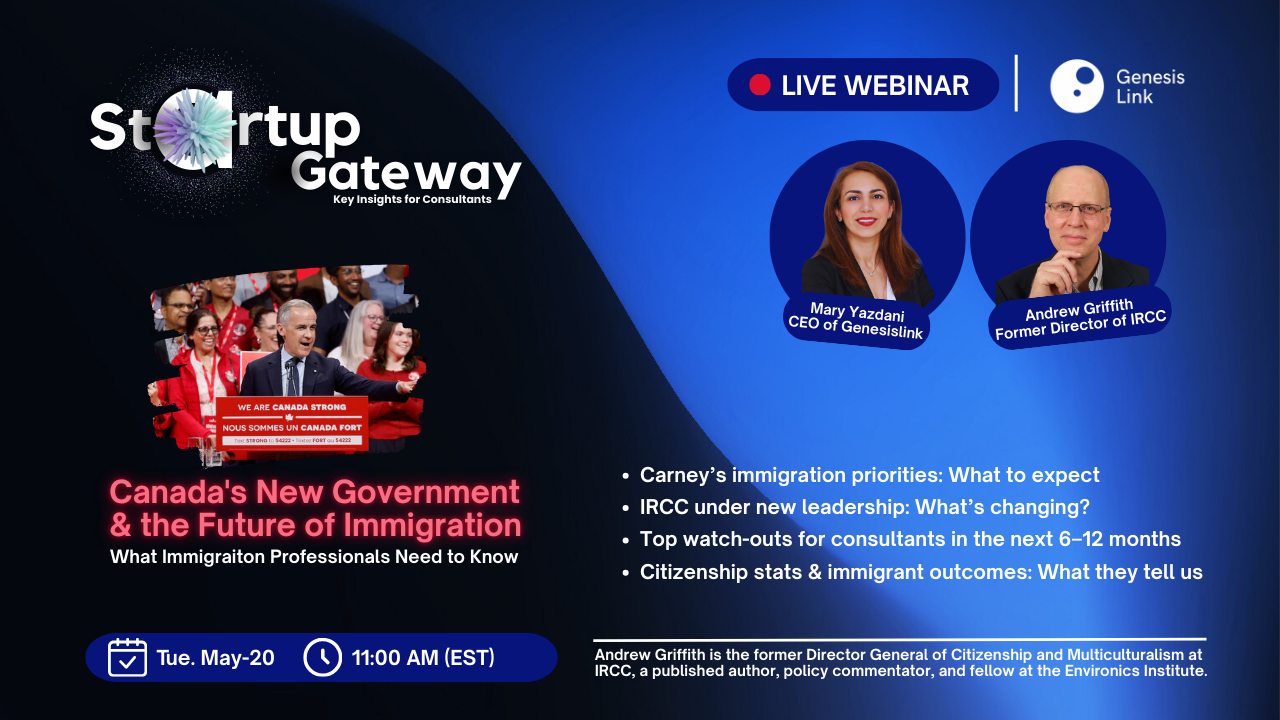
In this Startup Gateway webinar hosted by Mary Yazdani, Founder of GenesisLink, the discussion moved beyond processing times and refusal reasons — and into the political and structural realities shaping Canada’s immigration system.
Joining the conversation was Andrew Griffith, a former senior IRCC official and widely respected policy analyst, who offered rare and candid insight into how immigration decisions are actually made inside government — and why instability, frequent policy changes, and tightening scrutiny are not accidental.
This session was essential for anyone advising founders, startups, or investors who assume immigration decisions are purely technical. They are not.
Why Measuring Outcomes Has Become a Political Issue
Andrew opened with a foundational challenge in Canadian immigration policy:
“We are not very good at measuring outcomes.”
Across programs such as the Startup Visa and Global Skills Strategy, evaluations repeatedly reach the same conclusions:
- Weak performance measurement
- Limited outcome tracking
- Insufficient evidence of real-world economic and social impact
This matters because governments no longer ask only:
- Does the program meet policy objectives on paper?
They now ask:
- Can we prove it delivers results on the ground?
For business immigration, this shift translates into:
- Stronger documentation requirements
- Deeper scrutiny of business progress
- Higher expectations of measurable economic contribution
Stakeholder Pressure vs. Political Reality
One of the most important insights concerned the competing pressures inside government.
Andrew described a constant tension:
- Stakeholders (businesses, regions, industries) push for more immigration
- Political leadership faces pressure to limit numbers amid housing, healthcare, and affordability concerns
Every minister must balance:
- Short-term political optics
- Long-term economic needs
- Public confidence in the system
“That tension never goes away. It’s one to watch.”
This explains why:
- Programs tighten even when demand exists
- Changes can appear sudden or contradictory
- Stability is difficult to sustain
Why Immigration Policy Is So Complex (and Stays That Way)
Another structural reality: complexity is baked into the system.
Andrew compared immigration policy to tax policy:
- Every rule has an interest group
- Every simplification creates resistance
- Every program has downstream consequences
As a result, reform is slow — and often fragmented.
Critically, he noted:
- AI and digitization cannot succeed without simplification
- The more complex the rules, the higher the risk of arbitrary or inconsistent decisions
For SUV applicants, this means:
- Automation may increase speed
- But inconsistency risk rises when rules are unclear
Attraction Is Not Enough: Canada’s Retention Problem
A major theme was retention — an issue often overlooked in immigration debates.
Andrew highlighted that:
- Roughly 30% of immigrants leave Canada within 10 years
- Many departures are driven by:
- Housing affordability
- Healthcare access
- Unmet expectations
For business immigrants, the risk is even higher:
- Long delays
- Uncertainty
- Inability to operate at startup speed
“You attract people first — but if expectations aren’t met, they’ll take their talent elsewhere.”
For the Startup Visa, this has serious implications:
- Long processing times actively undermine innovation
- Founders cannot pause innovation cycles for 40+ months
Public Confidence: The Invisible Constraint
Andrew emphasized that public opinion quietly shapes immigration policy.
Recent surveys (including Focus Canada studies) show:
- Declining public support for high immigration levels
- Concerns are less about integration
- More about capacity: housing, hospitals, infrastructure
A common sentiment:
“Why are we admitting so many people when I wait 12 hours in emergency rooms?”
This framing matters because:
- Even strong economic programs tighten when public confidence drops
- Undocumented overstays and enforcement gaps erode trust
For business immigration, legitimacy and transparency are now critical.
What to Watch in the Next 6–12 Months
When asked what professionals should monitor, Andrew highlighted several key signals.
1) The New Minister’s Tone
The absence of clear public statements suggests:
- Short-term continuity is likely
Real direction will emerge through:
- Major speeches
- Parliamentary questioning
2) Immigration Levels Plan Consultations
The annual levels plan is where:
- Stakeholder pressure becomes visible
- Policy priorities are negotiated
- Winners and losers emerge
This process will shape:
- How SUV competes with programs such as the Global Skills Strategy
3) U.S.-Based Talent Opportunity
Andrew flagged a strategic opening:
“There is a real opportunity to recruit U.S.-based talent.”
Other countries are moving aggressively. Canada may:
- Expand use of the Global Skills Strategy
- Target recruitment of:
- Doctors
- Academics
- Highly skilled professionals
Whether this happens depends entirely on political will.
4) Public Opinion Surveys (Fall)
Upcoming surveys will reveal whether support:
- Stabilizes
- Declines further
- Rebounds slightly
These results directly influence:
- Caps
- Quotas
- Enforcement tone
Income Data: A Surprising Reality for Business Immigrants
One of the most counterintuitive findings shared:
Business immigrants show the lowest median income among immigration streams.
This challenges assumptions — and explains reform pressure.
Andrew shared deeper insights from census data:
- Citizens earn more than non-citizens
- Non-citizens earn roughly 80–85% of citizen income
- The income gap has narrowed over the past decade (a positive trend)
Key caveat:
- This is correlation, not causation
- Citizens tend to be more educated and skilled
Still, this data shapes how policymakers assess long-term integration success.
Why Policy Changes Feel Constant (and Often Abrupt)
A recurring audience question was why IRCC policies change so frequently.
Andrew’s answer was candid:
- Pressures emerge continuously
- Governments often react quickly
- Consequences are not always fully modeled
Mary added a practical observation:
- Policies are sometimes introduced to solve one issue (e.g., housing)
- But create new problems elsewhere
- Forcing rapid reversals
Andrew emphasized the political dynamic:
- Elected officials like announcements
- Public servants must manage the consequences
This explains ongoing volatility.
What This Means for Startup Visa Applicants
Several hard truths emerged:
- SUV operates in a political ecosystem, not a vacuum
- Processing delays reflect systemic capacity limits
- Designated organizations exist because government cannot judge startups directly
- Higher scrutiny is structural, not temporary
Andrew’s advice was direct:
“If you want credibility, show outcomes — not just intentions.”
He recommended:
- Including realistic performance indicators
- Documenting progress, even as plans evolve
- Acknowledging experimentation and risk honestly
This strengthens, rather than weakens, credibility.
Key Takeaways for Founders & Immigration Professionals
- Immigration policy is tightening under public pressure
- Business immigration must now prove real outcomes
- Stability is unlikely in the short term
- Data-driven, well-documented files are essential
- Long delays undermine innovation — and this tension is now recognized
- Designated organizations and consultants play a critical gatekeeping role
“Startup Visa remains valuable — but only if it demonstrates real economic contribution.”