


Business Plan Strategy That Succeeds with IRCC: Why Templates, AI-Only Drafts & Weak Inputs Are Failing SUV Files
Business Plan Strategy That Succeeds with IRCC: Why Templates, AI-Only Drafts & Weak Inputs Are Failing SUV Files
Updated 29-Jul-2025 • 11 min read
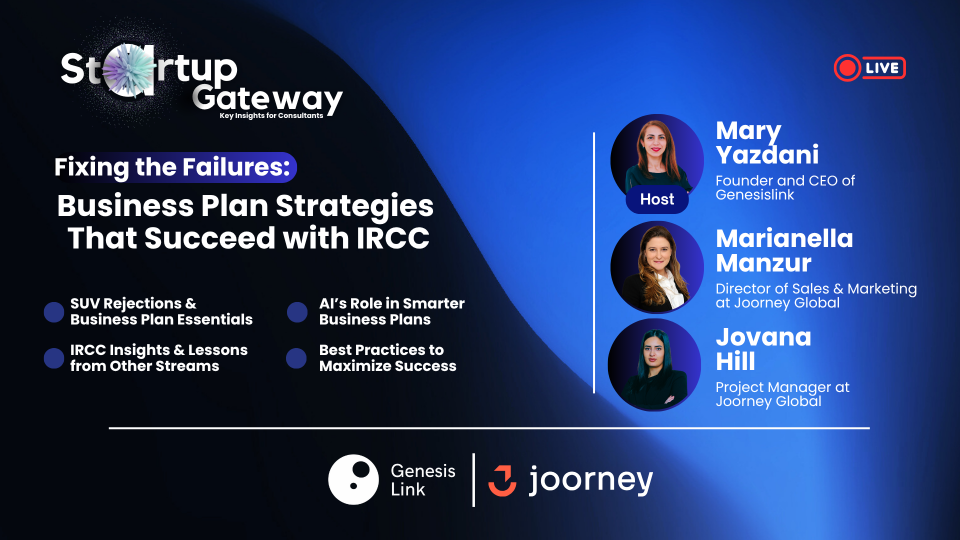
In this Startup Gateway webinar hosted by Mary Yazdani, Founder of GenesisLink, immigration professionals and founders examined one of the most frequent — and most misunderstood — reasons for Startup Visa (SUV) refusals:
The business plan.
While SUV refusals can involve multiple factors, IRCC feedback increasingly shows that the business plan is the central lens through which officers assess feasibility, credibility, innovation, and founder fit.
Joining Mary were two experienced practitioners working daily at the intersection of immigration and business planning:
- Marianella Manzur — Partner & Director of Sales and Marketing
- Jovana Hill — Project Manager specializing in Canadian immigration business plans
Their insights were not promotional — they were grounded in real refusal patterns, revision requests, and evolving IRCC expectations.
Why IRCC Is Zeroing In on Business Plans
Mary opened by linking this session to a previous webinar where GenesisLink reviewed official IRCC statistics showing:
- Growing PR inventory and processing delays
- Higher scrutiny across all SUV stakeholders
- Increasing unpredictability in business immigration assessments
What has become clear is that IRCC no longer treats the business plan as a checkbox.
Instead, officers are reading it as:
- A strategy document
- A credibility test
- A proxy for whether founders truly understand — and can execute — their business in Canada
The Most Common Weaknesses in SUV Business Plans
Jovana outlined two recurring failure points she sees across rejected files.
1) Weak Innovation Narrative
Innovation is a core SUV requirement, yet many plans fail to explain it convincingly.
Common issues include:
- Vague claims of being “innovative” without proof
- Poor differentiation from existing market solutions
- Failure to explain why current options do not meet market needs
True innovation does not require inventing something entirely new. More often, it involves:
- Combining existing solutions in a novel way
- Improving efficiency, accessibility, or outcomes
- Applying a known solution to a new market or context
What matters is clear explanation, not buzzwords.
2) Lack of Business Viability & Execution Detail
Many founders identify a real problem — but stop short of explaining how the business will actually operate.
IRCC, incubators, and reviewers increasingly expect:
- Day-to-day operational clarity
- Defined founder roles and responsibilities
- Realistic revenue logic
- Credible timelines and milestones
Red flags include:
- $1M revenue projections with no team, timeline, or go-to-market strategy
- Ambitious growth with no scalable model
- Generic milestones copied from templates
“A good idea without execution detail doesn’t survive scrutiny.”
Beyond SUV: Similar Patterns in C10, C11 & ICT Refusals
Marianella noted that these issues are not limited to the Startup Visa program.
Across C10, C11, and ICT applications, practitioners are seeing:
- Refusals based on minor documentation gaps
- Retroactive application of newer standards
- Heightened demand for Canadian business activity evidence
In some cases, refusals appear disconnected from application quality — suggesting broader policy and integrity objectives at play.
This has led to:
- Increased legal challenges
- Growing frustration among well-prepared applicants
- A need for stronger, more defensible documentation
What IRCC Is Really Signaling
Mary summarized a critical shift:
“The business plan is no longer just proof that you have an idea.
It’s proof that your strategy makes sense — and that it aligns with your background.”
Founder experience, market logic, and execution realism must now align tightly.
The AI Question: Tool or Liability?
A major portion of the session focused on the growing use of AI tools such as ChatGPT in drafting business plans.
Where AI Helps
AI can be useful for:
- Brainstorming
- Organizing thoughts
- Improving grammar and clarity
Used correctly, it can increase efficiency.
Where AI Fails
Jovana explained that AI-generated business plans often raise red flags because they tend to be:
- Generic (statements that could apply to any business)
- Operationally vague (no real “how”)
- Untailored to immigration programs
Common issues include:
- Missing program-specific requirements
- Failure to emphasize innovation, economic benefit, or founder roles
- Over-reliance on “best practices” instead of concrete actions
“AI won’t emphasize the right things unless it’s explicitly told to — and even then, it needs expert review.”
Market Research: The Biggest AI Weak Spot
One of the strongest warnings concerned AI-generated market research.
Key problems include:
- No credible citations
- Reliance on free, public, or outdated sources
- Inability to access premium databases
AI tools cannot access paid sources such as:
- Industry reports
- Proprietary databases
- Professional market intelligence platforms
Even worse, AI can misinterpret data — turning a small survey or speculative comment into an “industry fact.”
Without human verification, this can undermine the entire plan.
Why “Human + AI” Still Wins
Both speakers agreed: there is no such thing as a one-click immigration-ready business plan.
At present:
- AI is a support tool, not a replacement
- High-quality plans require human judgment, research, and program expertise
“The future is human plus AI — not AI alone.”
The Power of Inputs: Why Questionnaires Matter
Mary highlighted a reality many consultants know well:
A business plan is only as strong as the inputs behind it.
Jovana explained that vague or incomplete questionnaire responses lead to:
- Generic narratives
- Credibility gaps
- Misalignment with founder intent
While professionals can refine strategy, core decisions must come from the founder, including:
- Business model
- Revenue streams
- Product or service design
- Location and operational choices
These cannot be guessed — or averaged.
How Revisions Satisfy IRCC Concerns
When IRCC raises business plan concerns, Marianella explained that successful revisions typically involve:
- Deeper research
- Stronger evidence
- Tangible business activity (clients, suppliers, pilots, testing)
- Removal of unsupported claims
“IRCC is looking for substance and reality.”
If a claim cannot be supported, it should be removed, not defended.
Financial Projections: How Much Detail Is Enough?
Key guidance shared during the session:
- Most programs require 5-year annual projections
- Some streams require monthly projections for year one
- Investment funds (VC or angel) are typically included
- Founder funds and investor funds should be shown separately
- At later PR stages, progress matters more than the original forecast
Business Plans at LOS vs PR Stage
An important clarification emerged:
- The LOS business plan remains valid
- But after years of backlog, IRCC expects evidence of progress
This is where the following become critical complements to the original plan:
- Progress reports
- Updated activities
- Market testing
- Pilots and validation
Key Takeaways from the Session
- Business plans are central to SUV success — not a formality
- Generic or templated content is increasingly risky
- AI is a tool, not a solution
- Credible sources and human-verified research matter
- Strong intake and follow-up are as important as writing
- There is no checklist — only consistency, logic, and realism
“The business plan is one piece of the puzzle — but it touches every criterion IRCC cares about.”